
08
2022
-
07
Applications of Dry Vacuum Pumps in Solvent Recovery
BOKE VAC
Dry vacuum pumps, owing to their water‑free, oil‑free operation and broad applicability in vacuum processes, have been widely adopted across numerous industries. In recent years, as these pumps have become more prevalent, they have garnered increasing recognition from customers. Solvent recovery is primarily targeted at the chemical and pharmaceutical sectors. Prior to the advent of dry vacuum pumps, many applications relied on liquid‑ring vacuum pumps, water‑jet pumps, steam‑jet pumps, Roots‑plus‑liquid‑ring systems, or Roots‑plus‑water‑jet configurations.
Dry vacuum pumps, owing to their water-free, oil-free operation and broad applicability in vacuum processes, have been widely adopted across various industries. In particular, in recent years, with… Dry vacuum pump With its growing popularity, it is increasingly gaining recognition from customers.
Solvent recovery is primarily targeted at the chemical and pharmaceutical industries. Prior to the advent of dry‑type vacuum pumps, many processes relied on liquid‑ring vacuum pumps, water‑jet pumps, steam‑jet pumps, Roots‑plus‑liquid‑ring systems, and Roots‑plus‑water‑jet configurations. In these systems, volatile solvents carried by the vacuum stream enter the pump and come into contact with water or steam. Not only is the recovered solvent lost, but the resulting wastewater must also be treated before discharge, leading to high operating costs. Moreover, since liquid‑ring pumps, water‑jet pumps, and steam‑jet pumps consume substantial amounts of energy, customers seeking to reduce energy use and lower costs often explore retrofitting these systems to achieve greater efficiency and enhanced economic benefits.
Dry vacuum pump Its emergence effectively addresses the aforementioned issues. Its water‑free and oil‑free characteristics ensure that the process fluid remains uncontaminated from the moment it enters the pump until it exits—essentially, “what goes in is what comes out.” Solvent recovery can be achieved by installing heat‑exchanging equipment, such as condensers, at the exhaust port. Moreover, because dry‑type vacuum pumps offer higher efficiency than other types, they consume less energy, and their ultimate vacuum level remains stable regardless of ambient temperature fluctuations, resulting in a more reliable system. Consequently, they have found widespread adoption among today’s chemical and pharmaceutical customers. In our current client experience, the capital investment in dry‑type vacuum pumps can typically be recouped within one year—or even in less than six months.
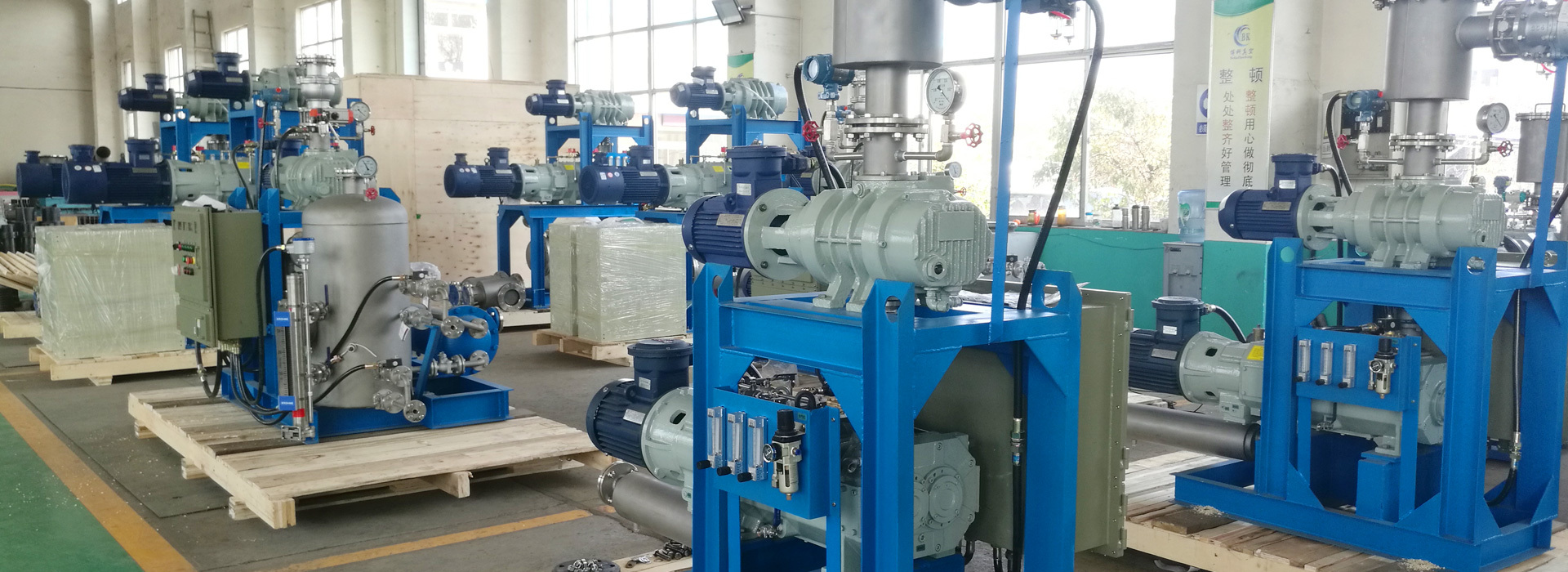
Dry vacuum pump The operating precautions are as follows:
1. Before startup, verify that the cooling water, power supply, and gas source (nitrogen or steam) are all properly connected and available.
2. Before starting, ensure the outlet valve is open and that venting is unobstructed. After opening the outlet valve, briefly jog the dry vacuum pump to confirm that the motor rotates in the correct direction. It is strictly prohibited to start the pump with the outlet valve closed; if the outlet valve is closed, ensure that both the inlet and outlet isolation valves are fully open. ()
3. For dry vacuum pumps that have been idle for an extended period, it is recommended to manually turn the rotor before starting up (to prevent rusting or seizing); the rotor can be easily turned by hand prior to startup.
4. Prolonged operation without cooling water is strictly prohibited. It is recommended to interlock the pump and the cooling‑water system via a cooling‑water switch or similar device.
5. The pump shall be stopped immediately under any of the following conditions: severe leakage, abnormal vibration, unusual odor, sparks, smoke, abnormal noise, or sustained high current.
6. During operation, dry vacuum pumps should be regularly inspected and monitored for pump temperature (generally not exceeding ambient temperature plus the temperature rise), vibration, and noise levels.
7. Flow and pressure are stable, and the current does not exceed the rated value.
Sales call
Technical Consulting
Email box
Official website
Address
No. 6 Huacheng Road, Boshan District, Zibo City, Shandong Province
Copyright © 2026 Shandong Boco Vacuum Technology Co., Ltd.
丨 SEO独立站建设:中企动力 淄博 外贸Google推广
Hi